
Covert Communication in the Presence of Legitimate Transmission
Overview
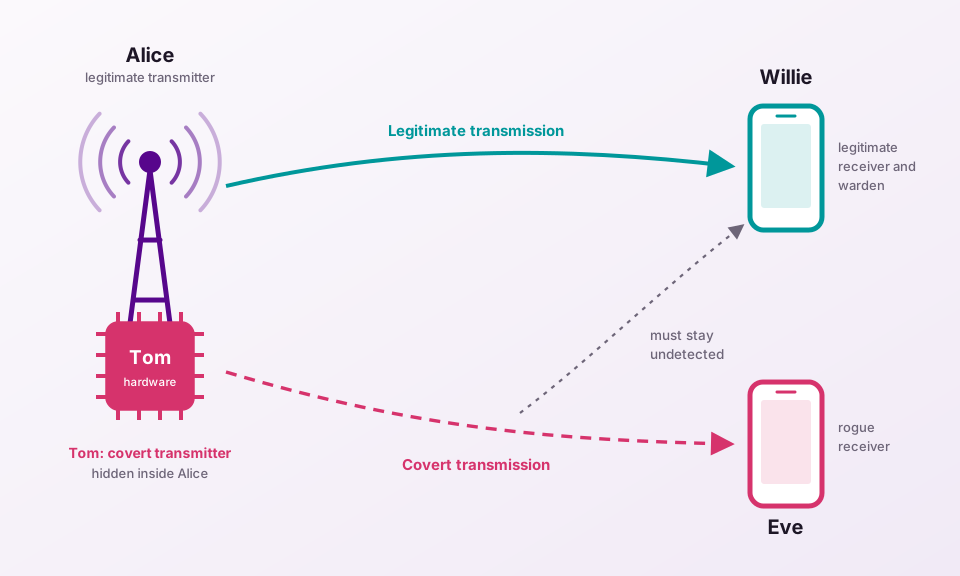
Covert communication hides a transmission within the randomness of a wireless channel, so that an adversarial warden cannot detect it. When receiver noise is the only source of randomness, the achievable covert rate goes to zero. Earlier work showed that a positive covert rate needs additional uncertainty, such as channel state known at the transmitter, noise variance unknown to the warden, or channel tampering the warden does not observe. For example, a hardware Trojan inside a legitimate transmitter can scale the pilots to corrupt the receiver’s channel estimate, then use the resulting mismatch to communicate covertly.
This project asks what happens when a legitimate link is active at the same time. We show that when the legitimate link operates at capacity, a positive covert rate is unattainable, even if the covert transmitter has better state or interference knowledge than the legitimate parties. A positive covert rate becomes possible when the covert transmitter has access to channel randomness unknown to the legitimate transmitter.
The pilot-attack work is a collaboration with Matthieu Bloch (Georgia Tech) and was supported in part by NSF.
Team
Faculty
Students
Aritra RoySerhat Bakirtas
Selected publications