
Geometry of Fixed-Autocorrelation Codes
Overview
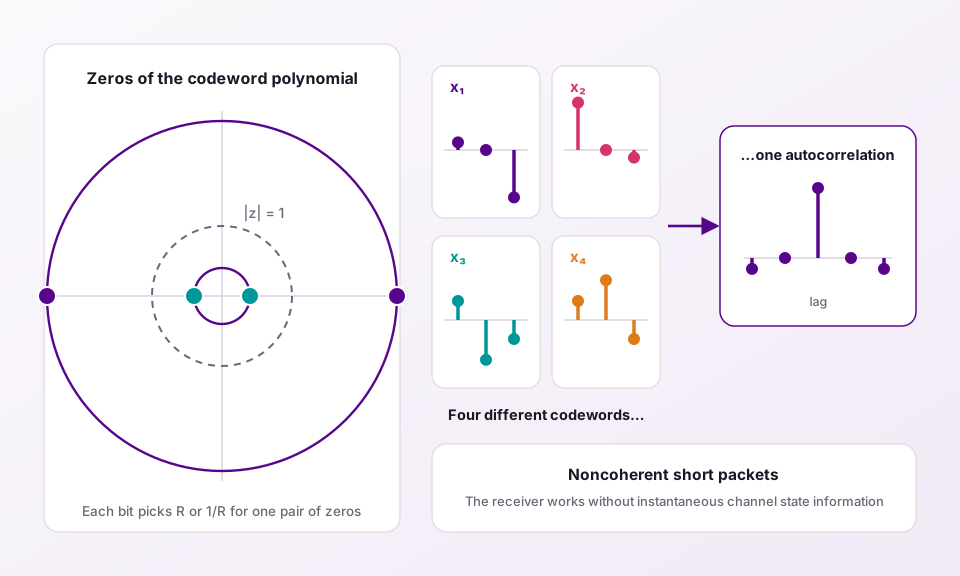
Emerging wireless applications, such as the Internet of Things, increasingly rely on short, sporadic transmissions. In these settings, training and synchronization take up a sizable fraction of the packet and can even dominate the information being sent. Noncoherent communication, where the receiver operates without instantaneous channel state information, is therefore an attractive approach for short packets.
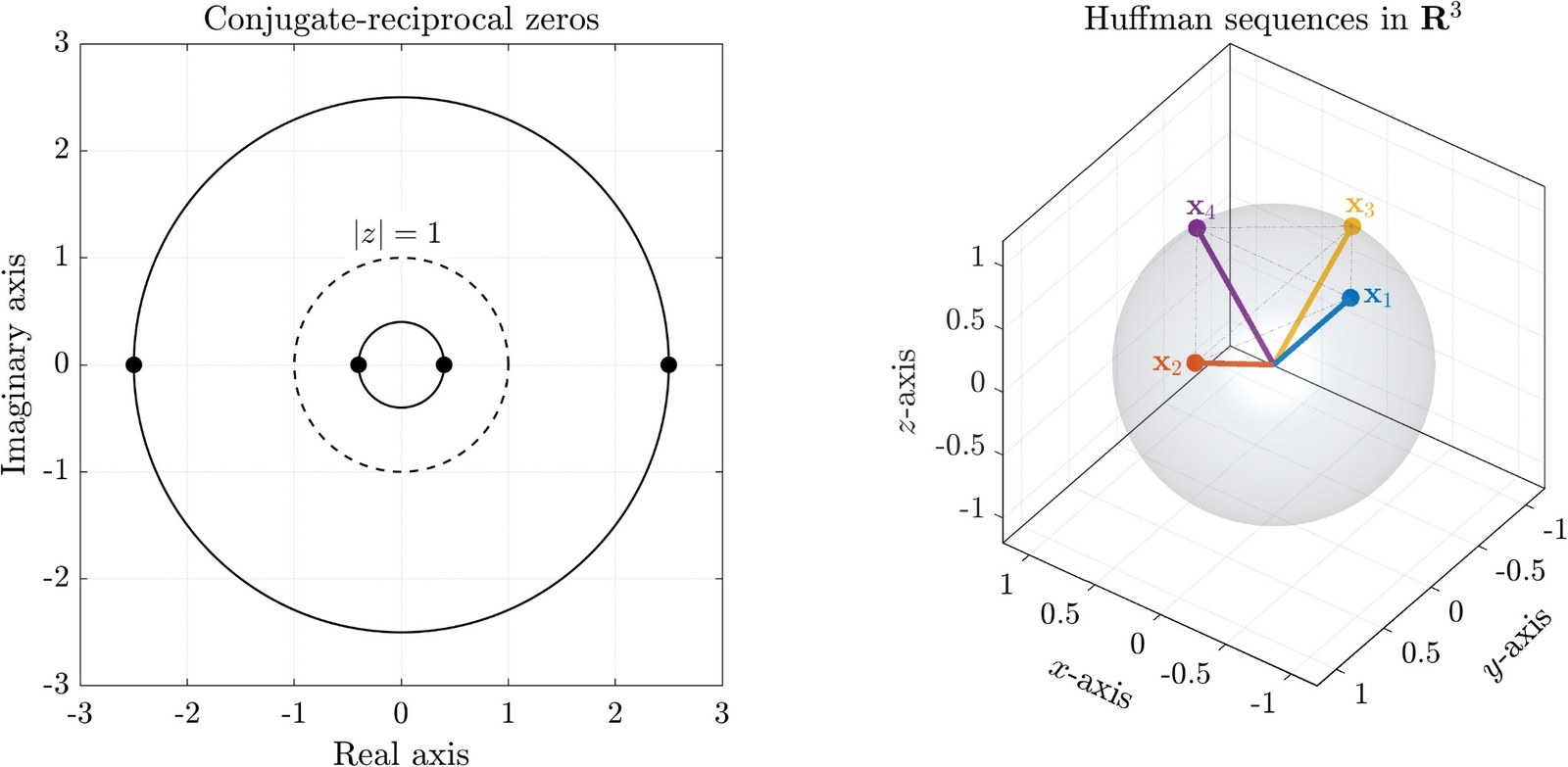
This project studies code design based on modulation on conjugate-reciprocal zeros (MOCZ), a noncoherent technique that conveys digital information through the zeros of polynomials. All MOCZ codewords share an identical aperiodic autocorrelation. To understand how this constrains the geometry of the code, we characterize the pairwise distances in arbitrary fixed-autocorrelation codes and derive lower bounds on the minimum distance of codes built from Huffman sequences. The approach exploits the algebraic structure of the polynomial zeros and establishes a relationship with geometrically uniform codes.
The work is a collaboration with Alphan Şahin (University of South Carolina). Code is available for the distance analysis and for Jutted BMOCZ.
Team
Faculty
Students
Parker Huggins
Selected publications