
Resilient Multi-User Mobile Sub-THz Networks using Near-Field Wavefronts
Overview
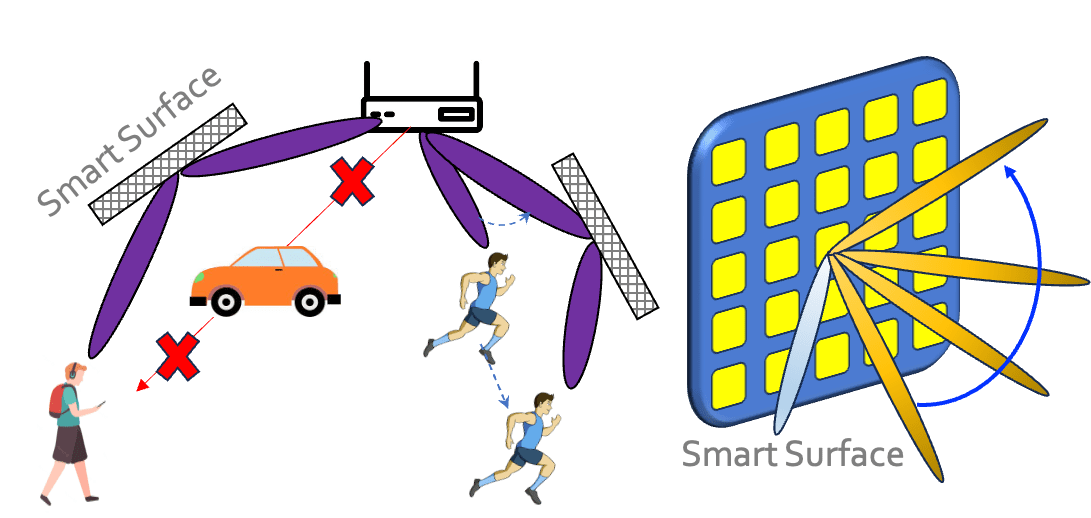
Communication above 100 GHz promises ultra-high data rates, but these links are fragile: they are easily blocked, and serving mobile users is hard. With large arrays and short wavelengths, the near field of a sub-THz transmitter can extend to several meters, so a base station or access point may serve near-field and far-field users at the same time.
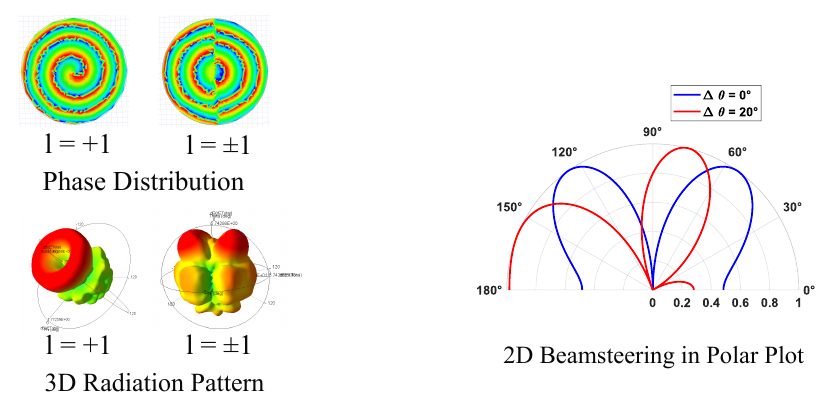
This project turns near-field propagation into an advantage. Near-field properties, such as curved beams that bend around obstructions and beams that reconstruct themselves after hitting an obstacle, can make sub-THz networks more resilient to blockage. The research has four thrusts:
- Modeling the fundamental limits of near-field wavefront shaping for agile, high-speed links under blockage.
- Designing and fabricating a new programmable array architecture that generates near-field wavefronts and adapts them to mobility and blockage.
- Power-efficient digital signal processing for tens of GHz of bandwidth.
- Interference modeling and multi-user communication across near- and far-field regions.
This is a collaborative project with Josep Jornet (Northeastern University), Yasaman Ghasempour (Princeton University) and Arjuna Madanayake (Florida International University). More on the project page.
Team
Faculty
Students
Wenpu Xia
Selected publications